Berkeley Scientists Burn Modern Papyrus Replicas to Help Decode Vesuvius Scrolls
World Pulse Editorial — The WORLD PULSE editorial team covers international news, business, technology, AI, science, sport, culture and other subjects of public interest. The desk applies source attribution, editorial checks, context and corrections standards across the publication.
The byline identifies the newsroom author or editorial team responsible for this publication. Where the story is based on external reporting, those sources are identified below.
AI-assisted production may have been used in the drafting workflow. Source verification, attribution and editorial review remain the responsibility of WORLD PULSE.
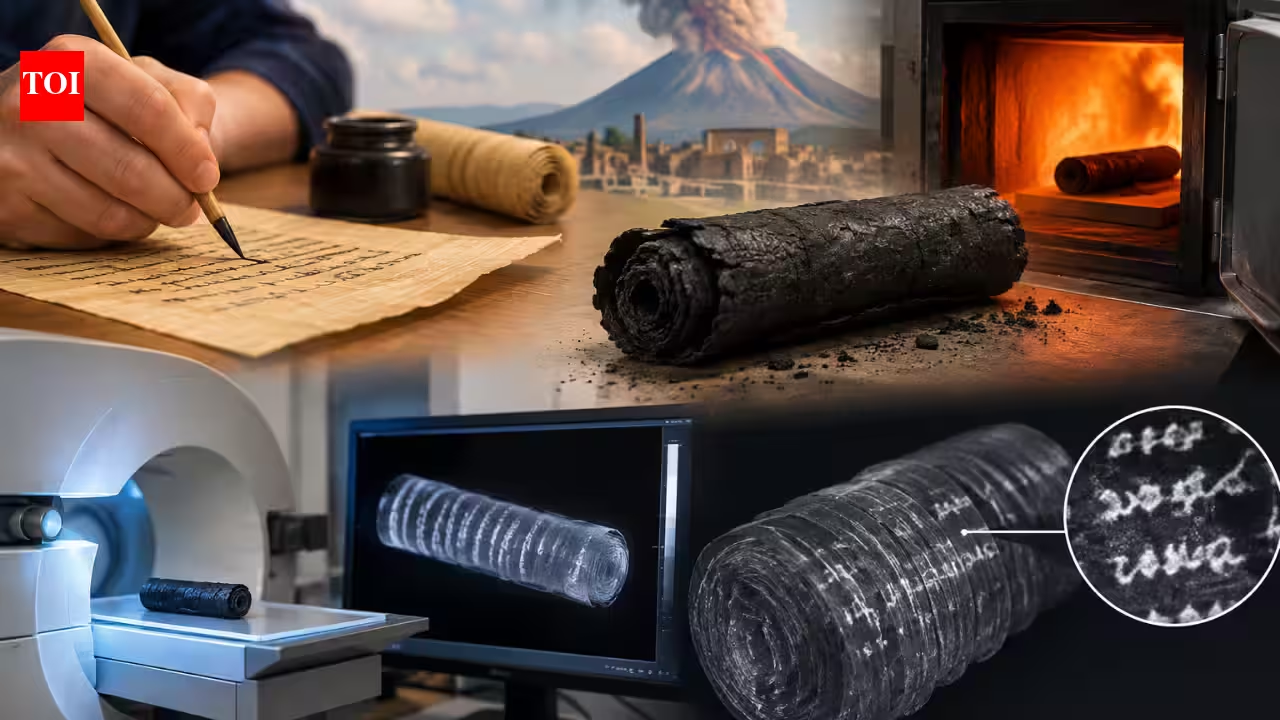
Researchers at UC Berkeley have carbonised modern student-written papyrus scrolls to test how leaded ink absorbs X-rays, aiming to help unlock the contents of the ancient Herculaneum library without damaging fragile artefacts.
To investigate how writing might be recovered from carbonised papyrus scrolls buried by the eruption of Mount Vesuvius, scientists at the University of California, Berkeley, created modern papyrus replicas and set them on fire. Published in the journal PLOS ONE, the study details how researchers prepared contemporary scrolls using ink containing different amounts of lead before carbonising them in a low-oxygen environment. The resulting experiments demonstrated that leaded ink could stand out dramatically in X-ray scans, offering a promising method to identify ancient scrolls whose hidden writing may be recoverable.
The experiment addresses one of archaeology's most challenging collections: the Herculaneum scrolls. When Mount Vesuvius erupted in 79 CE, volcanic material buried an ancient Roman town near modern Naples, Italy, including a library containing over a thousand papyrus scrolls. The extreme heat carbonised the texts, turning them into fragile, blackened objects. While the process preserved the manuscripts, it created a severe obstacle for researchers, as physically opening the scrolls can cause irreversible damage or destroy them entirely. As the only known intact library from antiquity, the collection holds texts that have never been read in the modern era, prompting ongoing efforts to look inside without unrolling them.
A primary obstacle in reading the ancient material is that ordinary carbon-based ink and carbonised papyrus share similar visual properties under X-ray techniques. Because both contain carbon, the contrast between the written letters and the surrounding papyrus is extremely weak, making it difficult for X-ray computed tomography (CT) scans to distinguish individual characters. To overcome this limitation, the Berkeley-led team explored whether lead could provide a stronger signal. Because lead is much denser than carbonised papyrus, it interacts differently with X-rays. The researchers found that leaded ink absorbed up to 25 times more X-rays than the surrounding charred papyrus, causing the handwritten letters to stand out clearly.
To conduct the test, researcher Douglas Seiler prepared papyrus, reed pens, and ink containing varying concentrations of lead. High school students then wrote passages on the modern papyrus, including lines from Star Wars, Bible verses, and a quotation from the television series The Outer Limits. Researchers rolled the papyrus into scrolls, placed them in a low-oxygen container, and heated them in a high-temperature furnace to replicate the physical condition of the ancient Herculaneum material. Using model scrolls allowed scientists to experiment, scan, and process the material repeatedly without risking irreplaceable historical artefacts.
Following carbonisation, the experimental scrolls were examined using X-ray CT and X-ray fluorescence techniques. The tests revealed that lead concentrations as low as 25 micrograms per square centimetre could be successfully detected. According to the researchers, this suggests that scientists could potentially use inexpensive handheld X-ray fluorescence scanners as an initial screening tool to identify scrolls containing leaded ink before prioritizing them for detailed X-ray CT imaging.
Detecting letters is only part of the challenge, as a scroll consists of tightly packed layers of papyrus that must be separated computationally. The team tested software originally developed to map the internal layers of lithium-ion batteries, adapting the programme to follow the complex geometry of a carbonised scroll and produce a flat, unfolded representation of its surface. Because the team already knew the exact text written on the experimental scroll, they could compare the original writing with the computer-generated reconstruction to evaluate the effectiveness of the software.
The research does not mean that scientists have already read previously inaccessible Herculaneum scrolls using the technique, but it provides a viable method for identifying which specimens might be easier to decipher. While previous breakthroughs have relied on advanced artificial intelligence and machine-learning systems, the new lead-detection approach could provide a powerful supplementary signal when lead is present, ultimately helping researchers recover text lost since antiquity without opening fragile originals.
### Why the Berkeley experiment is useful
The experiment addresses a specific technical problem: carbonised Herculaneum papyri are so fragile that physically opening many of them risks destroying the very writing researchers want to recover. X-ray imaging offers a non-destructive alternative, but the ink and papyrus can be difficult to distinguish because both were transformed by the ancient eruption.
The Berkeley team's modern replicas provided a controlled way to test how different inks behave after carbonisation. The finding that lead-containing ink produced a stronger X-ray signal gives imaging researchers a measurable feature to look for when examining ancient material.
The experiment does not mean that every Herculaneum scroll can now be read automatically. The researchers still have to deal with complex three-dimensional surfaces, damaged material and the challenge of reconstructing writing from scans. Instead, the work improves the scientific basis for identifying where hidden text may be detectable.
That distinction is important because the value of the research is methodological: it helps bridge experimental materials science, X-ray imaging and classical scholarship.
**Source note:** World Pulse's report focuses on the experiment and its implications rather than presenting the work as proof that all unreadable scrolls can immediately be decoded. The underlying study was reported through the cited scientific and news sources.
Topic coverage
Follow recurring subjects across the WORLD PULSE newsroom.
Topics
Reader interest
Most read
 UKKelsey Parker Welcomes New Baby Named River Following Heartbreaking Stillbirth
 AIOpenAI Discloses New Safety Issues and Outlines Plan for Tracking Incidents
 SportsAsian Games Facing Accommodation Crisis and Weather Disruptions in Nagoya, Japan
More from the newsroom
Latest stories
 UKUK Defence Secretary Wes Streeting Urges Public Preparation for Cyber, Climate and Supply Chain Emergencies
 USAFederal Charges Filed Against Virginia State Senator L. Louise Lucas in Alleged Racketeering Scheme
 WorldRising Islamophobia and the Democratic Response to Attacks on Muslim Candidates
 ScienceGlobal Biodiversity Fund Faces Criticism as Pharmaceutical Contributions Stagnate at $7,000
 TechnologyMemphis City Council Rejects One-Year Data Center Moratorium in Favor of 135-Day Halt
 WorldDiplomatic and Military Developments in the Middle East: Iran, Russia, and Regional Security Updates
 WorldRubio Denounces Ukraine’s Claims of Withdrawn U.S. Support as ‘Scandalous’ Amid Oslo Diplomacy
 USATrump Administration Proposes Tying Federal Transit Funding to Local Birth and Marriage Rates
Research & context
Explore WORLD PULSE reference pages
Use these newsroom indexes to follow related coverage, review publication timelines and explore how WORLD PULSE reporting is organized.
Sources & attribution
The external reports, announcements or publications used to inform this article are listed here for attribution and reader context. A source link does not mean WORLD PULSE independently endorses every claim in that source.
Questions about sourcing, attribution or corrections: contact the newsroom.
